Holbrooks Miniature and Model Club
Coventry club that meets every two weeks. Display of members work.
More Than a Club
Every club has an origin story. Holbrooks Miniature and Model Club began with a simple conversation.
In early 2024, miniature maker Graham Bolton was attending community events at Holbrooks Community Centre, displaying his work and sharing his passion for creating realistic miniature scenes. It was there that he met the Centre Manager, who recognised that this was a hobby capable of bringing people together. She asked Graham a straightforward question: would he consider starting a miniature and model club?
The answer was an enthusiastic yes.
With little more than a handful of flyers, a meeting room and the hope that a few like-minded people might be interested, Holbrooks Miniature and Model Club opened its doors in April 2024. No one quite knew what to expect.
The response exceeded every expectation.
Around twenty people attended that first meeting. Some were experienced miniature makers, while others had never built anything more complicated than a flat-pack bookcase. They arrived with different interests, different skills and different reasons for coming, but they all shared a curiosity about making things with their hands.
Word spread quickly.
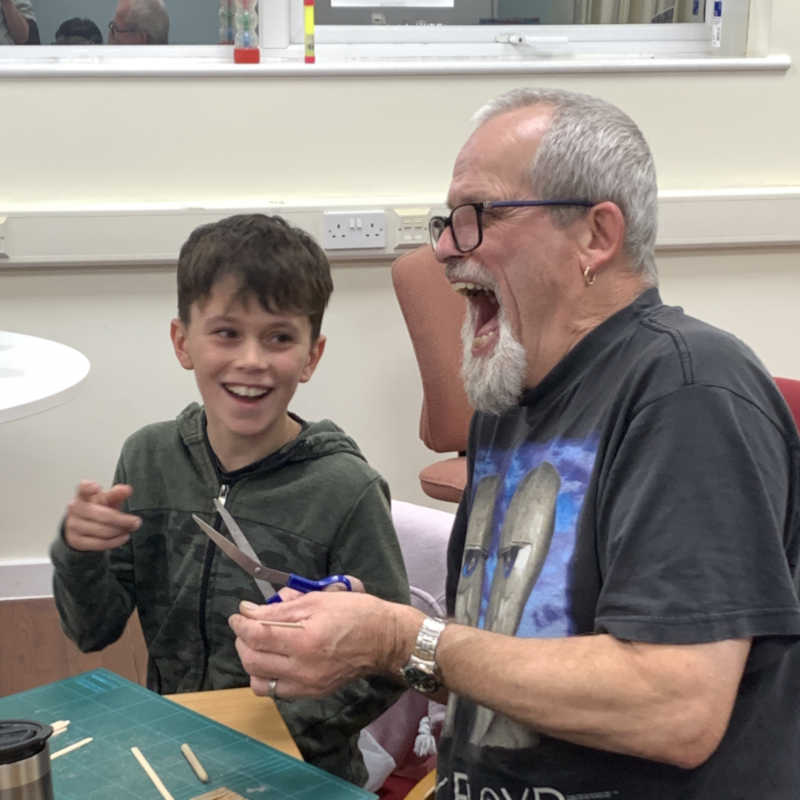
Today, the club has grown to more than forty members, ranging in age from just eight years old to over eighty. It has become one of those increasingly rare places where generations work side by side, sharing ideas, techniques and plenty of laughter. A retired engineer might be helping a young member build a piece of furniture, while someone who specialises in dolls’ houses swaps painting tips with a railway modeller. Across the room, another member may be sculpting miniature food, weathering brickwork or demonstrating how to scratch-build an object from everyday materials.
That diversity has become one of the club’s greatest strengths. Under one roof you’ll find doll’s house enthusiasts, railway modellers, figure painters, scratch builders, engineers, artists and complete beginners, each bringing something different to the table. No single discipline dominates. Instead, every skill enriches the others.
Perhaps most remarkable of all is the atmosphere. In some hobbies, knowledge can be closely guarded, with newcomers left to discover techniques through trial and error. Holbrooks has embraced the opposite philosophy. Here, experience is something to be shared. If a member has learned a new technique, they’ll happily demonstrate it. If someone asks how to scale a drawing, lay realistic brickwork or weather a model, the answer is never, “Work it out yourself.” Instead, it’s, “Come and sit with me. I’ll show you.”
That spirit of generosity has shaped the club from the very beginning. Members don’t simply create miniatures. They encourage one another, solve problems together and celebrate each other’s successes. Before long, newcomers become confident enough to pass those same skills on to the next person.
Holbrooks Miniature and Model Club may have started with a chance conversation and a room full of strangers, but it has become something far greater than a place to build models. It has grown into a creative community where friendships are formed, knowledge is freely shared and every member, whatever their age or experience, has something valuable to contribute.
The Power of a Shared Project
From the very beginning, Holbrooks Miniature and Model Club set out to be different. Rather than everyone working independently on their own models, members wanted to create something together. The idea was simple: choose a project large enough, varied enough and interesting enough that every member, whatever their age or experience, could contribute.
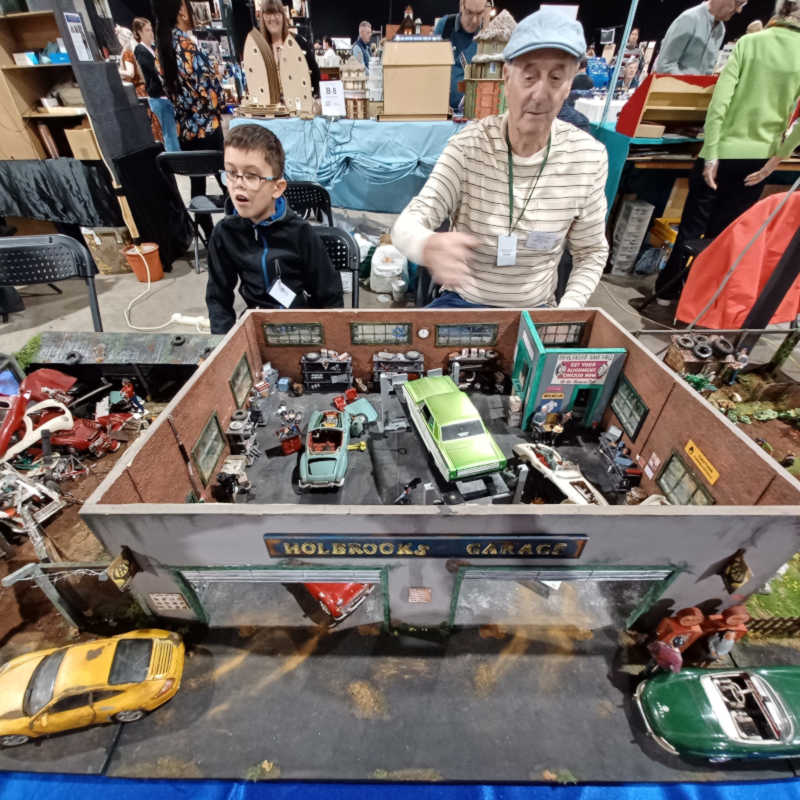
The club’s first major collaborative build was an authentic 1980s garage and vehicle repair workshop.
It was an unusual choice. Miniature exhibitions are, quite naturally, dominated by beautifully furnished dolls’ houses. Graham and the members decided to head in a different direction. A working garage offered something rarely seen on the exhibition circuit and immediately captured people’s imagination. It appealed not only to traditional miniature enthusiasts but also to classic car lovers, model engineers, railway modellers and families. Visitors who might normally have wandered past another dolls’ house found themselves stopping to explore every corner of the bustling little workshop.
More importantly, it was a project that everyone could help create.
Instead of dividing the work between a handful of experienced builders, the garage became dozens of miniature projects within one larger scene. Some members constructed the buildings themselves, carefully recreating the architecture of a busy local garage. Others concentrated on the surrounding scenery, adding realistic textures, fencing and roadside details that brought the setting to life.
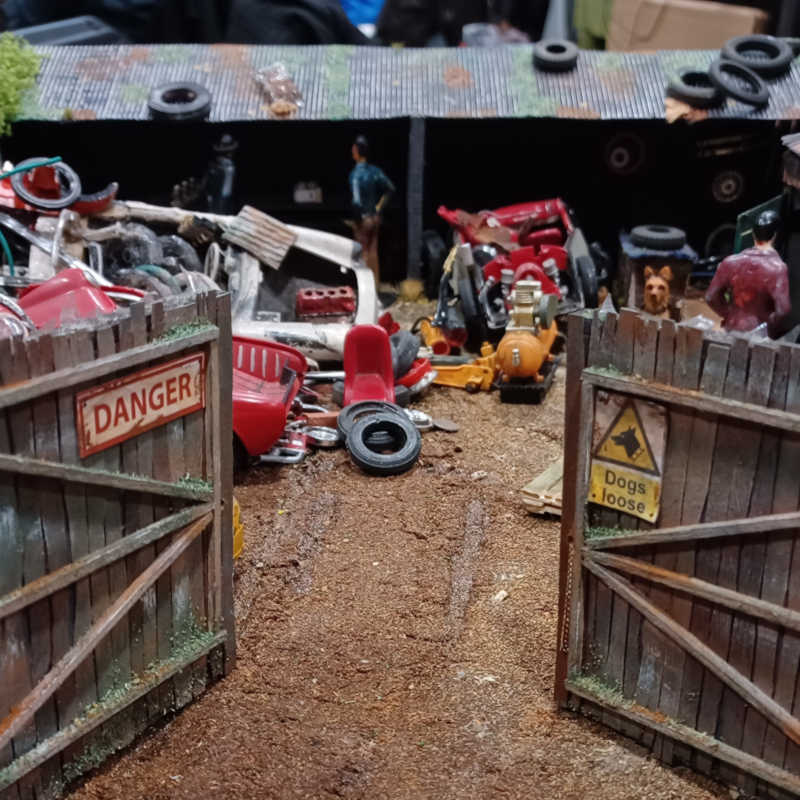
The allotments became a project in their own right, with members painstakingly sculpting tiny vegetables from polymer clay before planting them in carefully prepared plots. Elsewhere, members scratch-built sheds and outbuildings, while others focused on weathering techniques, transforming pristine models into buildings that looked as though they had stood for decades beneath British skies.
The garage workshop quickly filled with stories of its own. Mechanics were posed working beneath vehicles on the inspection pit, others leaned over open bonnets or prepared cars ready for collection. Outside, the scrapyard steadily grew as children enthusiastically painted and distressed donated model cars, creating rows of damaged vehicles waiting to be dismantled. Their contributions became one of the highlights of the finished display, proving that even the youngest members could play an important role in creating a realistic scene.
What made the project so special was that every detail represented somebody’s contribution. There wasn’t one master builder responsible for the finished display. Every shed, every weathered wall, every vegetable, every car and every scenic detail reflected the skills and imagination of different members working towards a common goal.
When the garage made its exhibition debut, the response was overwhelmingly positive. Visitors were drawn to something they hadn’t seen before. Instead of simply admiring another beautifully decorated dolls’ house, they found themselves exploring a recognisable slice of everyday Britain, full of tiny stories waiting to be discovered. Car enthusiasts smiled at the workshop details, families enjoyed spotting the scrapyard vehicles and miniature enthusiasts appreciated the craftsmanship throughout.
The project proved something that has become central to Holbrooks Miniature and Model Club. A collaborative build is about far more than the finished model. It creates opportunities for people of every age and skill level to learn from one another, contribute their own talents and take genuine pride in saying, “I helped build that.”
Building The Frog and Trumpet
Having discovered just how successful a collaborative project could be, the club was ready for its next challenge. If the garage had celebrated Britain’s love affair with the motor car, the next project would celebrate another great British institution: the local pub.
Not just any pub, but a wonderfully familiar corner of 1970s Britain, complete with green tiled frontage, etched windows, well-worn furniture and all the little details that instantly transport visitors back in time.
Every great project begins with an idea, and The Frog and Trumpet was no exception.
The first few meetings were spent around the table with notebooks, photographs and cups of tea, discussing what made a traditional pub feel authentic. Members shared memories of pubs they had visited, favourite features they remembered from childhood and the tiny details that people often overlook. The conversations ranged from the practical to the wonderfully eccentric. Should there be a cigarette machine? What would be behind the bar? How shabby should the toilets look? Would there be a piano? What should the pub be called?
Naming the pub became a project in itself, with suggestions flying around the room before The Frog and Trumpet eventually emerged as the clear favourite.
Once the plans had been agreed, construction could begin.
As with the garage, the work naturally divided itself into dozens of smaller projects. Andrew designed and produced precision laser-cut kits that allowed members to construct furniture and architectural details with remarkable accuracy. Workshops became a regular feature of club nights, giving everyone the chance to learn new techniques while working on parts of the larger display.
Members discovered the art of laying miniature brickwork, carefully fixing individual bricks before learning how to grout and weather the finished walls to give them the appearance of decades of use. Others concentrated on making furniture, assembling tables and chairs before adding years of imaginary wear and tear.
No detail was considered too small.
Tiny ashtrays appeared on the tables after one particularly popular workshop. Crisp packets were painstakingly researched and recreated from authentic 1970s designs before being folded and assembled by hand. Miniature cakes and buffet food were sculpted with astonishing realism, while signs, posters and advertisements gradually filled the walls with familiar touches from the period. Every shelf, every picture frame and every ornament helped tell the story of a well-loved local.
Perhaps the greatest strength of the project was that everyone found their own niche. Some members preferred precision construction, others enjoyed painting and weathering, while those with artistic or graphic design skills produced signs, packaging and decorative details. Every contribution, no matter how small, became an essential part of the finished scene.
Alongside the model itself, another collaborative project quietly took shape.
Throughout the build, members documented the journey in a beautifully illustrated scrapbook. More than a simple record of progress, it became a diary of the club itself. Photographs, workshop notes, sketches, milestones, humorous observations and behind-the-scenes moments were all carefully preserved. It captures not only what was built, but how it was built, recording the friendships, laughter and shared achievements that accompanied every stage of the project.
Looking through its pages, it becomes clear that The Frog and Trumpet is much more than a beautifully crafted miniature pub. It is the combined work of dozens of imaginations, hundreds of hours of shared craftsmanship and countless conversations around the club table. Every brick, every chair, every cake and every tiny packet of crisps tells the story of somebody who learned a new skill, shared an idea or helped another member bring the project to life.
The finished model may be measured in inches, but the collaborative spirit that created it is immeasurable.
More Than Miniatures
Spend an evening at Holbrooks Miniature and Model Club and you’ll quickly discover that the models are only half the story.
Of course, there are beautiful miniatures everywhere. Buildings take shape one brick at a time, furniture emerges from sheets of laser-cut wood and tiny everyday objects are transformed into works of art. But listen closely and you’ll hear something just as important: conversations. Advice being offered. Ideas being exchanged. Laughter as another problem is solved or another unexpected suggestion sends a project in a completely new direction.
That spirit of sharing lies at the heart of the club.
In many hobbies, knowledge can sometimes feel like a closely guarded secret. Techniques are perfected over years of experience and newcomers are expected to find their own way. Holbrooks has chosen a different path. Here, if someone discovers a better way to weather brickwork, build furniture or create realistic scenery, they don’t keep it to themselves. They show everyone else.
It is not unusual to see a beginner sitting alongside someone with decades of modelling experience, learning a new technique over a cup of tea. Today’s newcomer often becomes tomorrow’s teacher, passing on the skills they have only recently learned themselves. It creates an atmosphere where nobody is afraid to ask questions because everyone remembers what it was like to be starting out.
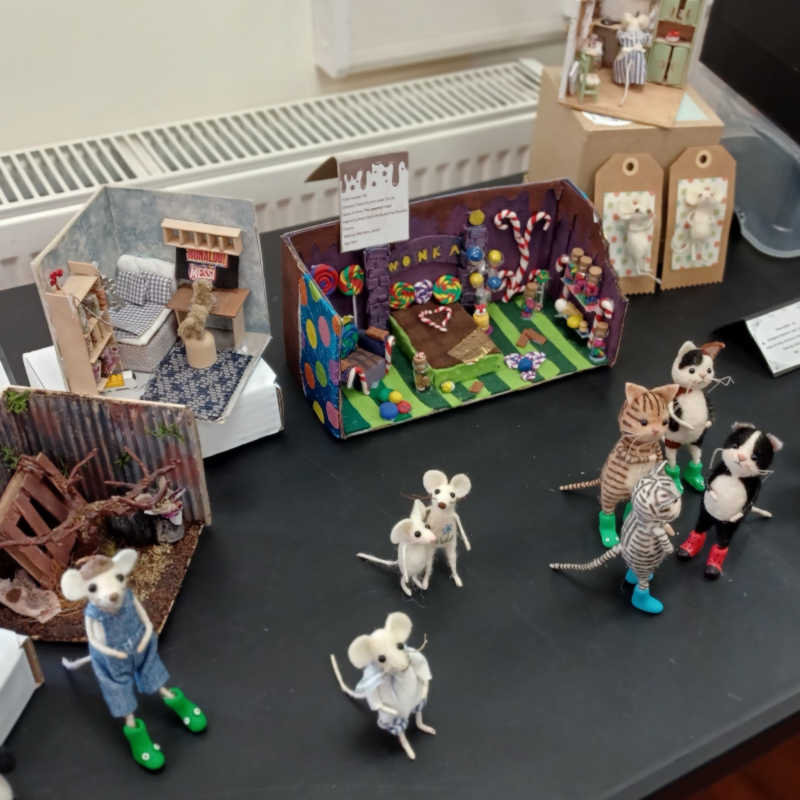
Although the collaborative projects remain at the heart of the club, members are also encouraged to bring along their own work. Club nights regularly feature personal projects in all kinds of scales and subjects, from dolls’ houses and railways to military models, fantasy figures, engineering projects and scratch-built creations. The variety is extraordinary and often provides inspiration for the next collaborative build.
Perhaps that is why the evenings feel as much like a social gathering as a club meeting. The tea is always flowing, conversations drift easily between modelling techniques and everyday life, and there is usually as much laughter as there is glue. Friendships have formed around the workbench, and members are quick to celebrate each other’s achievements, whether that is completing a beautifully detailed model or simply mastering a technique for the first time.
In recent years, many hobby clubs across the country have sadly disappeared. The pandemic brought an abrupt halt to countless community groups and, for some, the doors never reopened. Holbrooks Miniature and Model Club has taken the opposite path. Since its formation in 2024, it has continued to grow, welcoming new members of every age and ability while proving that traditional skills, shared creativity and face-to-face friendships still have an important place in modern life.
As one collaborative project reaches completion, conversations have already begun about the next. Ideas are being sketched, possibilities debated and imaginations set racing once again. Whatever the subject turns out to be, one thing is already certain: it won’t be built by one person. It will be built by everyone.
The finished models may fit on a tabletop, but they represent something much larger. Every brick, every chair, every weathered wall and every tiny packet of crisps tells the story of someone who learned a new skill, shared an idea or helped another member bring an imagination to life.
In a world that can often feel increasingly disconnected, Holbrooks Miniature and Model Club reminds us that some of the strongest communities are still built by hand, one tiny piece at a time.